The negative gearing debate has dominated headlines throughout 2025, with Treasury modelling requests sparking political controversy during the April federal election campaign. But as Australia’s property market hits record valuations and buyers navigate increasingly complex decisions, what does the data actually tell us?
Australian Property Market October 2025: Current State
Australia’s residential property market reached $11.8 trillion in October 2025, growing by $678 billion over the past year. National housing values rose 2.2% in the September quarter (the largest quarterly increase since May 2024) with annual growth at 4.8%.
Brisbane property prices have surged 9.5% year-on-year, Sydney is up 3.4%, and Melbourne has climbed 2.3%. Brisbane has overtaken Melbourne to become Australia’s second-most expensive housing market for the first time.
Meanwhile, the expanded First Home Buyer Guarantee launched on October 1st, allowing virtually unlimited applicants to enter with just 5% deposits, immediately intensifying competition in the sub-$1 million segment.
Negative Gearing Impact on Property Prices: The Real Numbers
The mathematics are surprisingly modest. Australia has approximately 1 million negatively geared properties with an average tax deduction of $8,700 annually, translating to roughly $2,700 in after-tax benefit for the typical investor.
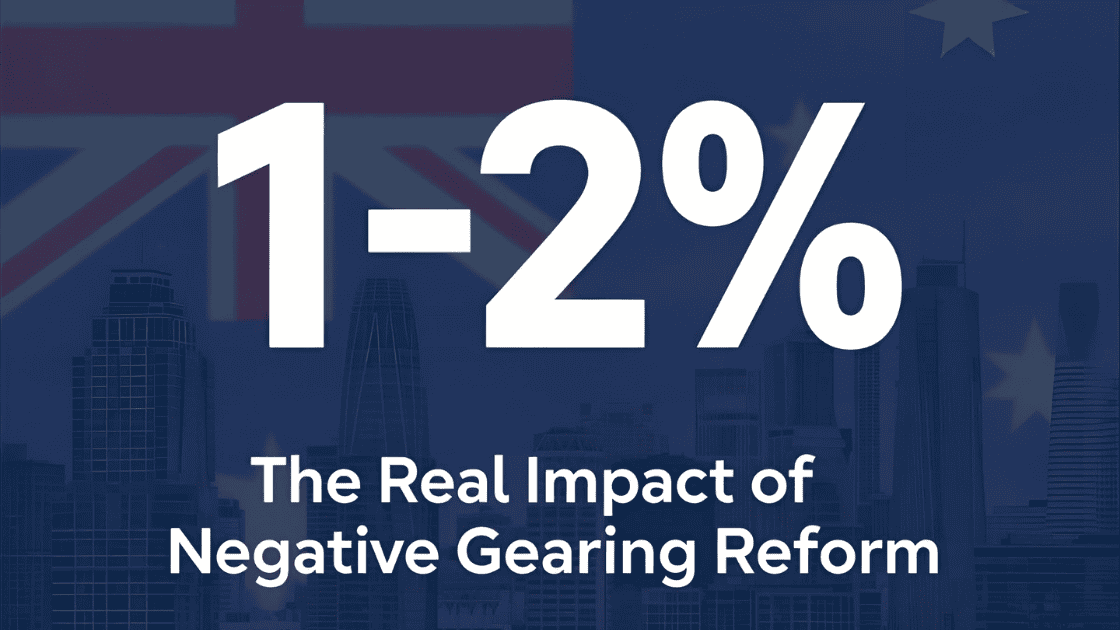
Research consistently shows removing negative gearing would reduce property prices by just 1-2%, not the double-digit drops many expect. Why? When your property appreciates $20,000-30,000 annually, most investors would simply absorb a $2,700 cost rather than sell.
Only 35% of Australian properties are investment properties. Of those, just a fraction are negatively geared to the point where removal would force a sale. The impact is mathematically contained.
Negative Gearing Policy 2025: Political Reality
The ACTU reignited the debate in August 2025, proposing limits on negative gearing to a single investment property. But both major parties have now ruled out changes, with Labor stating negative gearing reform is “not something that we are proposing” following the contentious election debate.
This mirrors historical patterns. Negative gearing reform has contributed to electoral defeats previously, revealing how deeply embedded the policy is in Australian investment strategies.
What Actually Drives Australian Property Prices
If housing affordability is the goal, the data points to more powerful levers:
- Property Supply Constraints: National listings are tracking nearly 20% below the five-year average, while sales volumes remain 1.9% above average. This supply-demand mismatch is the primary driver of current price pressure.
- Zoning and Planning Reform: Regulatory restrictions on density and height limits constrain supply far more than tax policy affects demand.
- Infrastructure Investment: Better transport connections expand liveable geography, redistributing demand and moderating price concentration.
- Broad Land Tax: A comprehensive land tax of 1-3% would fundamentally alter holding costs for unproductive land use, far exceeding negative gearing’s impact.
- Migration and Population Growth: Australia’s population is forecast to exceed 30 million by 2030, with close to 3 million additional people requiring housing. Population growth consistently adds 1-2% to annual price growth.
Australian Rental Market 2025: The Real Concern
The most contentious aspect isn’t property prices but rental affordability. Median apartment rents are forecast to grow 24% between 2025 and 2030, with 92% of 2-bedroom apartments expected to exceed $700 weekly by 2030, and vacancy rates falling from 1.8% to 1.1%.
If investors exit the market without equivalent renters transitioning to ownership, rental supply tightens further. Not every renter has the deposit, income stability, or credit profile to buy, even at modestly lower prices.
Property Investment Strategy 2025: Beyond Negative Gearing
Smart property investment has never relied primarily on negative gearing. The fundamentals that matter:
- Capital Growth Potential: Driven by employment, infrastructure, and demographic trends
- Rental Yield Analysis: Returns that make financial sense relative to the asset price
- Location Fundamentals: Including supply constraints and demand drivers
- Financial Capacity: Ability to hold through market cycles regardless of tax treatment
Brisbane’s market in October 2025 shows these fundamentals in action, with strong demand across price brackets and the revamped 5% deposit scheme creating immediate impact in the sub-$1 million segment.
Properties requiring negative gearing to be financially viable are, by definition, marginal investments. The tax benefit masks weak fundamentals.
Property Buying Strategy October 2025
The current market demands clear-eyed analysis:
- Don’t Wait for Policy Change: A theoretical 1-2% price reduction over 12 months while the market grows 4-8% leaves you worse off. Total Australian residential property values increased by $678 billion over the past year. Policy speculation doesn’t stop market momentum driven by supply-demand imbalances.
- Focus on Intrinsic Value: In late 2025, with buyer demand strong and inventory 20% below average, properties with genuine locational advantages, infrastructure access, and employment growth will continue performing regardless of tax policy changes.
- Understand Opportunity Cost: Every month spent waiting for a policy-induced correction is a month of rent paid and potential appreciation missed. Time in the market beats timing the market.
- Identify Market Trends: Units are outperforming houses in Brisbane, Adelaide, Perth and Darwin as affordability pressures reshape demand. Understanding these shifts matters more than tax policy speculation.
Australian Housing Affordability: The Bigger Picture
Negative gearing dominates political discourse because it’s simple and emotional. But it’s a mathematical sideshow compared to the structural challenges of supply, planning restrictions, infrastructure deficits, and population growth outpacing construction.
Just under 10% of all taxpayers negatively geared properties in 2020-21, and more than 70% of property investors have only one investment property. This isn’t a system dominated by wealthy speculators but middle-income Australians using available policy to build wealth.
For buyers navigating today’s market, success comes from understanding fundamentals, acting on genuine value, and making decisions based on your financial capacity, not political speculation about tax policy that may never change and wouldn’t dramatically impact prices if it did.
Property Market Outlook 2025-2026
The Australian property market’s trajectory is set by supply constraints, population growth, and economic fundamentals. In October 2025, those forces point clearly upward.
Brisbane continues leading capital city growth at 9.5% annually. Sydney and Melbourne are recovering strongly. The First Home Buyer Guarantee expansion is reshaping the entry-level market. Rental vacancy rates remain critically low across all major capitals.
These are the factors driving property values in 2025, not hypothetical tax policy changes that remain politically unpalatable and have a modest projected economic impact.
Need help identifying property based on genuine market fundamentals rather than political speculation?
At Buyerbud, we specialise in data-driven property analysis, focusing on what actually drives long-term value in the Australian property market.
Key Takeaways: Negative Gearing and Australian Property 2025
- Removing negative gearing would reduce property prices by only 1-2% according to research
- Australia’s property market grew $678 billion to $11.8 trillion in the past year
- Brisbane property prices lead capital city growth at 9.5% annually
- Supply constraints (listings 20% below average) drive current price pressure more than tax policy
- Both major parties have ruled out negative gearing reform in 2025
- Rental market forecasts show 24% growth by 2030 with vacancy rates falling to 1.1%
- 70% of property investors own only one investment property
- Smart property investment focuses on capital growth, location, and yield, not tax optimisation